
By Matt Cottengim Rochester, NY
PUBLISHED 10:16 PM ET March 17, 2026
How Does a City Banner Program Work from Start to Installation?
Municipal leaders exploring a city banner program often want to understand what the process looks like from initial approval through installation.
While decorative banner programs are designed to be simple for municipalities, there is a structured process that ensures each program is customized, approved, and successfully implemented within the community.
Understanding how the process works helps cities feel confident moving forward with a program that enhances downtown streets, strengthens civic pride, and operates without placing additional burden on municipal staff or budgets.
Sponsorship-funded city banner programs provide a practical way for communities to enhance the appearance of their streetscapes without requiring municipal budget expenditures. Through partnerships with local businesses and organizations, cities can install decorative street banners that celebrate the identity of the community while recognizing the businesses that support it.
Community banner programs are commonly used to improve visual appeal, reinforce civic pride, and create a more welcoming environment throughout downtown districts, business corridors, and other prominent areas of a city. Community Showcase Banners’ program structure already reflects this model: the city authorizes pole use and supports the initiative, while Community Showcase Banners handles sponsorship fulfillment, production, and related coordination, with no cost to the municipality for sales and production.
Quick Answer
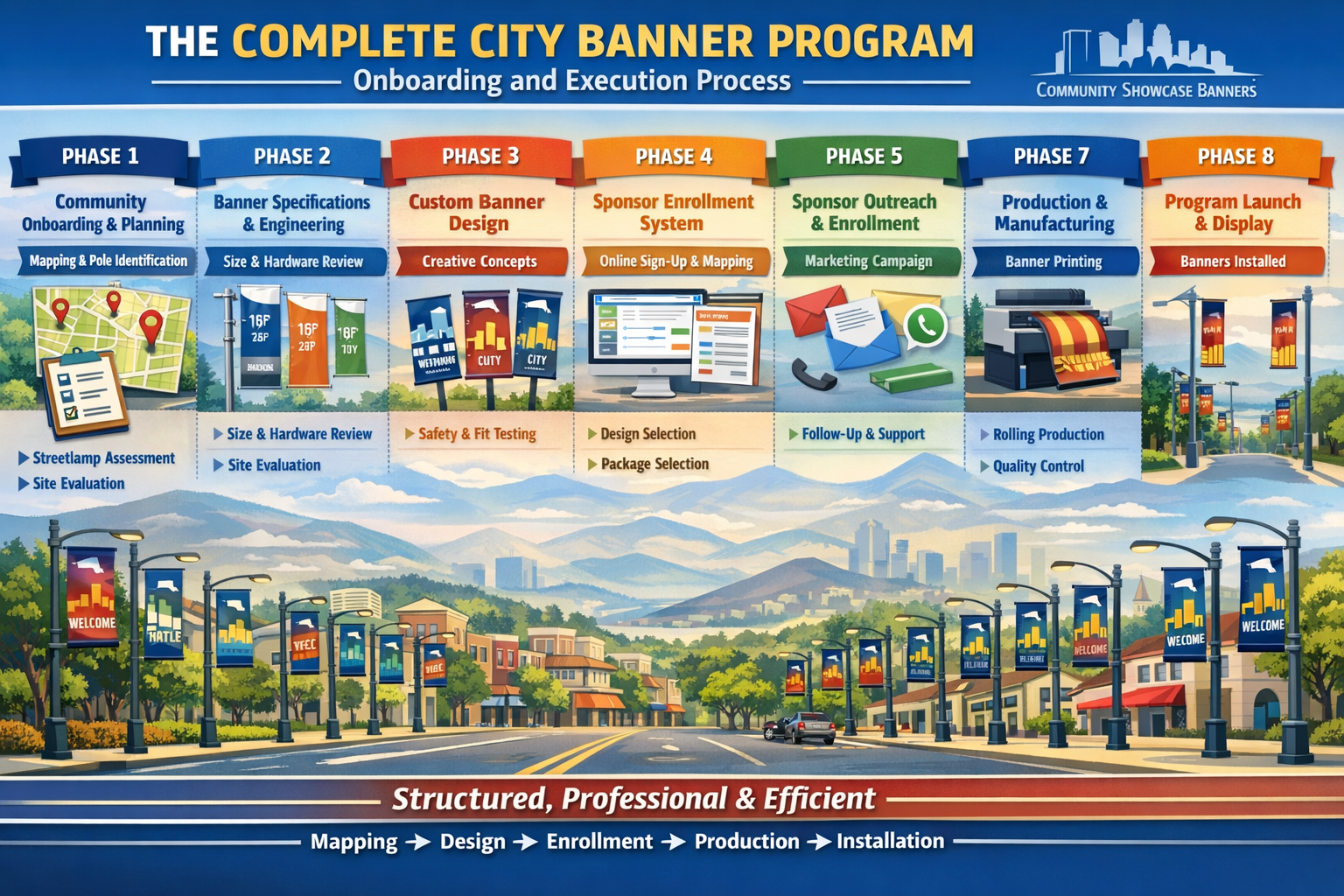
A city banner program typically follows a step-by-step process that includes identifying display locations, approving a banner agreement, designing custom banners, inviting local business sponsors to participate, manufacturing the banners, and coordinating installation throughout the community.
This process is designed to be handled in coordination with Community Showcase Banners while requiring minimal time and administrative effort from the municipality.
Step-by-Step: How a City Banner Program Works
Step 1: Identify Banner Display Areas
The process begins with identifying where banners will be displayed.
Municipal leaders review:
-
downtown streets
-
business corridors
-
main roadways
-
key community areas
A virtual review is typically conducted using mapping tools, followed by screenshots for city approval.
Cities identify:
-
preferred streets
-
specific poles or streetlamps
-
priority areas for beautification
A minimum number of poles is required to launch the program, with the ability to expand based on participation.
Step 2: Streetlamp Mapping and Approval
Once display areas are identified, a custom streetlamp map is created.
This map:
-
plots each approved pole
-
assigns a number to each location
-
allows for clear organization and sponsor selection
The city reviews and approves the final map to ensure all placements align with local requirements and infrastructure.
Step 3: Banner Agreement Execution
After confirming display locations, the municipality executes a simple agreement.
This agreement:
-
authorizes the use of approved poles
-
outlines the program structure
-
confirms the one-year display period
-
establishes the renewal framework
The agreement is designed to be straightforward and ensures both parties are aligned before moving forward.
Step 4: Hardware and Banner Specifications
Next, banner specifications are confirmed.
This includes:
-
banner size based on pole height and spacing
-
whether existing hardware is available
-
whether brackets or mounting equipment are required
This step ensures the banners are properly sized and safely installed.
Step 5: Custom Banner Design
Community Showcase Banners creates custom banner designs using the city’s branding.
Design elements may include:
-
city logo
-
color palette
-
fonts
-
slogans or taglines
-
community themes
The city reviews and approves the designs before production begins.
Cities may choose:
-
one consistent design
-
multiple rotating designs
Step 6: City Banner Sign-Up Page Launch
A dedicated City Banner Sign-Up Page is created for local businesses.
This page includes:
-
the city’s endorsement letter
-
banner design previews
-
a map of available locations
-
sponsorship options
-
a list of participating businesses
This page serves as the central hub for sponsor participation.
Step 7: Local Business Outreach and Enrollment
Local businesses are invited to participate in the program.
Outreach is conducted through:
-
phone calls
-
email communication
-
city-supported promotion
Businesses can:
-
select preferred banner locations
-
choose a sponsorship package
-
submit their logo or branding
Participation is voluntary and designed to highlight businesses that support the community.
Step 8: Artwork Finalization and Production
Once sponsors are confirmed, banner artwork is finalized.
This includes:
-
placing sponsor logos
-
preparing print-ready files
-
confirming all details with the city
Banners are then sent to production using durable materials designed for outdoor display.
Step 9: Installation Coordination
After manufacturing, installation is coordinated.
Banners may be installed by:
-
the city’s public works department
-
a local contractor
-
an installation partner coordinated by Community Showcase Banners
Installation includes:
-
placing banners on approved poles
-
ensuring proper alignment
-
securing all hardware
Step 10: Display, Maintenance, and Support
Once installed, banners remain on display for approximately one year.
During the display period:
-
maintenance is coordinated if needed
-
damaged banners can be replaced
-
the city and sponsors enjoy the visual impact of the program
Step 11: Renewal and Program Continuation
At the end of the display term:
-
the program may be renewed
-
new designs may be introduced
-
sponsors may continue participation
This creates an ongoing program that evolves with the community.
What the City Is Responsible For
The municipality’s role is focused and manageable.
Cities typically:
-
approve display areas and pole locations
-
provide an endorsement letter
-
review and approve designs
-
coordinate installation (or approve contractor use)
The program is designed so the city does not manage:
-
sponsor sales
-
payment processing
-
production logistics
What Community Showcase Banners Handles
Community Showcase Banners manages the operational side of the program, including:
-
sponsor outreach and enrollment
-
banner design and production
-
sign-up page creation
-
coordination of installation
-
program logistics and communication
This allows the city to benefit from the program without taking on operational burden.
Key Takeaways
-
City banner programs follow a clear, step-by-step process
-
The city’s role is focused on approvals and collaboration
-
Community Showcase Banners manages program execution
-
Local businesses fund the program through sponsorship
-
The result is a fully installed banner display with no municipal funding required
Related Resources
Interested in exploring a sponsorship-funded city banner program for your community?
Contact Community Showcase Banners to learn how the process works.

Matt Cottengim is an experienced professional with a strong background in sales, marketing, workflow automation, and business strategy. He serves as the Brand Affiliate for Community Showcase Banners, Inc., a company that specializes in decorative streetscape banner displays for municipalities. Matt is also an expert in software tools such as WooCommerce, ActiveCampaign, Monday.com, Airtable, Synthflow, Chat GPT, Fillout and Zapier, which he uses to optimize all aspects of the business’s operations.



Community Showcase Banners
130 E. Main St.
Rochester, NY 14604