
By Matt Cottengim Rochester, NY
PUBLISHED 12:55 AM ET March 19, 2026
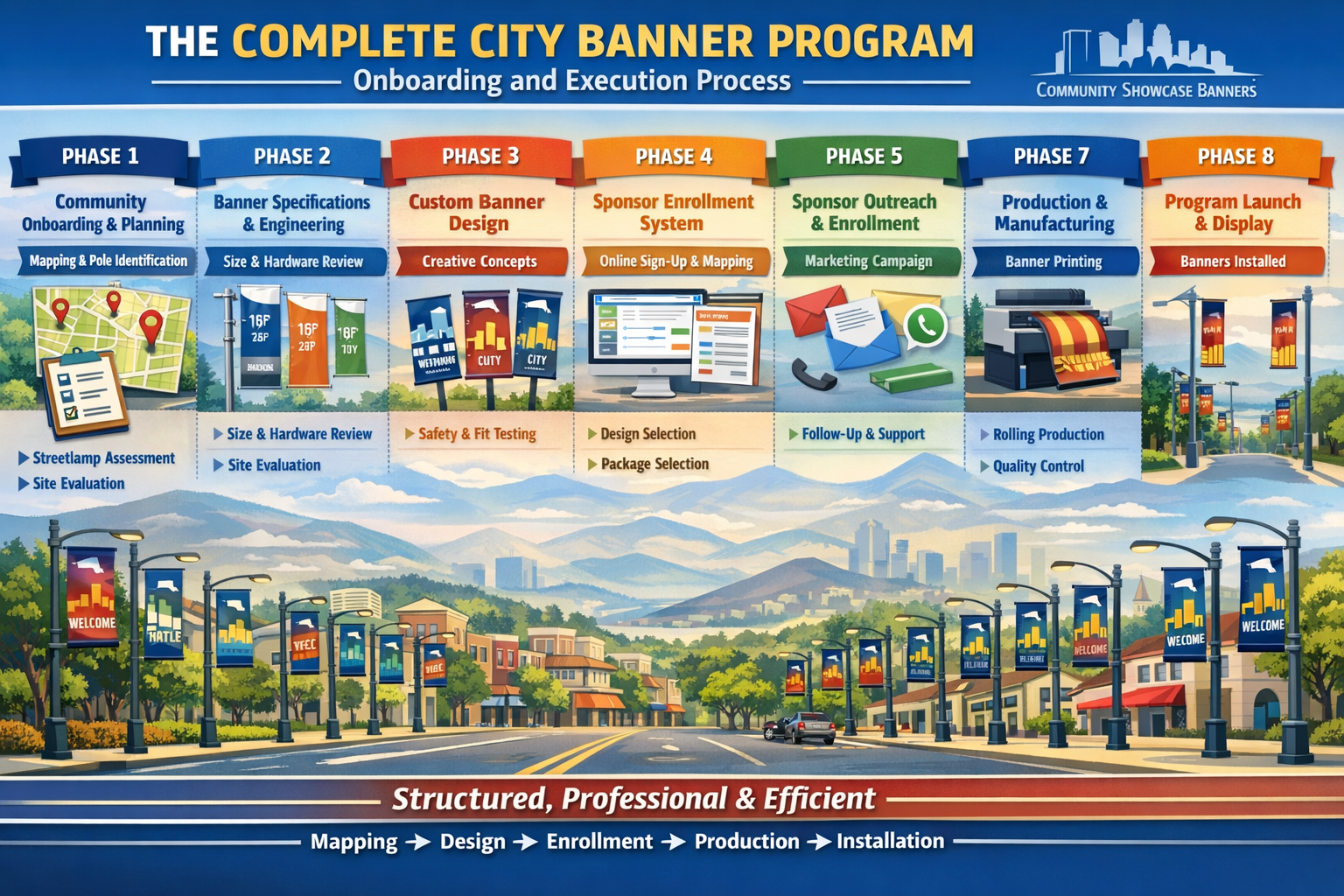
The Complete City Banner Program Onboarding and Execution Process
Municipal leaders evaluating a city banner program often want a clear understanding of what happens after approval, how the program is set up, and what to expect from start to installation.
This guide outlines the full onboarding and execution process used by Community Showcase Banners, providing a detailed look at how each phase is managed to ensure a successful, professionally implemented program.
Quick Answer
A city banner program follows a structured process that includes mapping and approving banner locations, confirming hardware and sizing, designing custom banners, launching a sponsor enrollment campaign, producing banners in phases, and coordinating installation.
This process is managed by Community Showcase Banners and is designed to minimize the time and workload required from the municipality.
Phase 1: Community Onboarding and Planning
Mapping and Pole Identification
The process begins with a detailed evaluation of the community using tools such as Google Maps, Street View, and interactive mapping platforms.
During this phase, Community Showcase Banners:
-
reviews city boundaries, downtown districts, and commercial corridors
-
evaluates street visibility, traffic flow, and pedestrian areas
-
identifies suitable streetlamps or poles
-
assesses whether banners have been used previously
Street View is used to analyze:
-
pole height and consistency
-
presence of existing hardware
-
clearance from roadways, sidewalks, and buildings
-
obstructions such as trees, signage, or awnings
Based on this evaluation, a preliminary list of recommended streets and poles is created and shared with the municipality for review.
Streetlamp Mapping and Inventory
Once approved, poles are plotted onto a structured streetlamp map.
Each pole includes:
-
a unique pole number
-
GPS coordinates
-
designation as single or double banner display
-
assigned banner size
-
hardware requirements
-
banner placement orientation (which side of the pole)
This map becomes the foundation for sponsor selection and installation planning.
Pole Count Strategy and Expansion
While most programs begin with a minimum number of poles, many expand based on demand.
Programs are often structured to:
-
begin with core corridors
-
maintain grouped, cohesive placement
-
expand outward as participation increases
In practice, cities frequently choose to extend banner placements along the same corridor rather than scattering them across unrelated areas.
Phase 2: Banner Specifications and Engineering
Banner Size Determination
Banner size is determined based on pole height and visibility.
Typical standards include:
-
smaller poles (under 10 feet): approximately 18” x 36”
-
mid-range poles (10–15 feet): 24” x 48” or 30” x 72”
-
taller poles (15+ feet): 30” x 72” or larger
Custom sizes may also be used based on specific city requirements.
Hardware Evaluation and Requirements
Each pole is evaluated to determine whether existing hardware is present or if new hardware is required.
When needed, cities may provide:
-
photos of poles
-
measurements of rod spacing
-
rod diameter
-
presence of end caps or fixed hardware
For poles with fixed hardware, precise measurements are critical to ensure proper banner fit.
Safety and Placement Considerations
Banner placement is carefully planned to ensure:
-
adequate clearance from roadways
-
no overhang into traffic lanes
-
proper visibility for drivers and pedestrians
Banners are typically installed between 10 and 16 feet above ground level to:
-
prevent damage from public interaction
-
maintain visibility within a driver’s line of sight
-
avoid obstruction by signage
Sample Testing for Fit
When hardware or measurements are uncertain, a sample banner is produced to confirm fit before full production.
This step helps prevent costly reprints and ensures proper installation.
Phase 3: Custom Banner Design
City Branding and Creative Direction
The design process begins by collecting branding materials from the municipality, including:
-
logos
-
color palettes
-
fonts
-
taglines
-
branding guidelines
Some cities provide detailed branding documents, while others rely on collaborative creative direction.
Design Development and Review
Community Showcase Banners develops initial design concepts based on:
-
city branding
-
community identity
-
visual consistency across the program
Typically, 2–3 design options are presented for review.
Cities may choose:
-
a single uniform design
-
multiple designs within a cohesive theme
Design Refinement
Designs are revised collaboratively until final approval is achieved.
Common approaches include:
-
rotating designs along a corridor
-
assigning designs to specific districts or areas
The process remains flexible and continues until the city is fully satisfied.
Phase 4: Sponsor Enrollment System
City Banner Sign-Up Page
A dedicated sign-up page is created to present the program to local businesses.
This page includes:
-
a city endorsement or invitation letter
-
before-and-after visual examples
-
approved banner designs
-
a live streetlamp inventory map
-
a list of participating sponsors
-
real-time availability of banner locations
Interactive Map and Selection
Businesses can:
-
view available and reserved poles
-
select preferred locations
-
see banner placement details
This creates transparency and encourages participation.
Sponsorship Packages and Checkout
Sponsors choose from structured packages that include:
-
number of banners
-
one-year display period
-
logo placement within banner design
-
ability to select preferred locations
Checkout includes:
-
selection of payment plan (monthly or full)
-
entry of pole numbers
-
optional logo upload
Real-Time Inventory Updates
As sponsors enroll:
-
selected poles are marked as reserved
-
availability is updated on the map
-
demand and participation become visible to others
Phase 5: Sponsor Outreach and Enrollment
Market Launch Strategy
Outreach begins with a coordinated launch:
-
initial email campaign to local businesses
-
follow-up phone outreach
-
direct engagement with decision-makers
Businesses are introduced to the program as a community sponsorship opportunity, not traditional advertising.
Follow-Up and Engagement
The process includes:
-
confirming receipt of information
-
answering questions
-
assisting with enrollment
Daily updates highlighting new participants help build:
-
social proof
-
momentum
-
competitive participation
Phase 6: Production and Manufacturing
Initial Production Order
After sponsor approvals are collected:
-
artwork is finalized
-
the first production batch is submitted
Manufacturing typically takes:
-
approximately 4 weeks for standard production
Rolling Production Model
Additional sponsors are handled through a rolling system:
-
new orders are submitted weekly
-
rush production is used for later participants
-
manufacturing timeline is reduced to approximately 2–3 weeks
Banner Construction
Banners are produced using:
-
durable 18 oz vinyl
-
reinforced stitching
-
pole pockets at top and bottom
-
grommets for secure fastening
Hardware includes:
-
fiberglass rods
-
stainless steel straps
-
zip ties and fastening components
Extra materials are provided to support maintenance and repairs.
Phase 7: Installation and Deployment
Installation Preparation
Installers are provided with:
-
a detailed pole map
-
a digital reference link
-
a numbered checklist of banner placements
Banners are labeled by pole number to ensure accuracy.
Installation Process
Banners are installed by:
-
city public works departments
-
or approved contractors
Installers typically:
-
stage banners in order
-
install sequentially along corridors
-
complete both sides of the street in a structured flow
Installation Timeline
Installation may take:
-
several weeks
-
up to one to two months depending on scale
Factors include:
-
weather conditions
-
staffing availability
-
access to poles
Phase 8: Program Launch and Display
The banner display period begins once installation is complete.
Programs are structured so that:
-
the display term begins after full installation
-
sponsors receive the full duration of visibility
-
the city benefits from a complete, cohesive display
Key Takeaways
-
The process follows a structured, multi-phase system
-
Mapping, design, and engineering are handled upfront
-
Sponsor enrollment is organized and transparent
-
Production is managed in both batch and rolling phases
-
Installation is coordinated with detailed planning tools
-
The program is designed for accuracy, safety, and scalability
Related Resources
-
Do City Banner Programs Cost the Municipality Money?
-
How Do Local Business Sponsors Participate in City Banner Programs?
-
How Does a City Banner Program Work from Start to Installation?
- What Does the City Need to Provide for a Banner Program?
-
The Complete Guide to Sponsorship-Funded City Banner Programs
Interested in exploring a sponsorship-funded city banner program for your community?
Contact Community Showcase Banners to learn how the process works.

Matt Cottengim is an experienced professional with a strong background in sales, marketing, workflow automation, and business strategy. He serves as the Brand Affiliate for Community Showcase Banners, Inc., a company that specializes in decorative streetscape banner displays for municipalities. Matt is also an expert in software tools such as WooCommerce, ActiveCampaign, Monday.com, Airtable, Synthflow, Chat GPT, Fillout and Zapier, which he uses to optimize all aspects of the business’s operations.



Community Showcase Banners
130 E. Main St.
Rochester, NY 14604