
By Matt Cottengim Rochester, NY
PUBLISHED 11:33 PM ET March 17, 2026
How Many Poles Are Needed to Launch a City Banner Program?
One of the first practical questions municipalities ask when exploring a city banner program is how many poles or streetlamps are required to get started.
Understanding the number of suitable banner locations helps determine whether a program is feasible and how it can be structured within the community.
Quick Answer
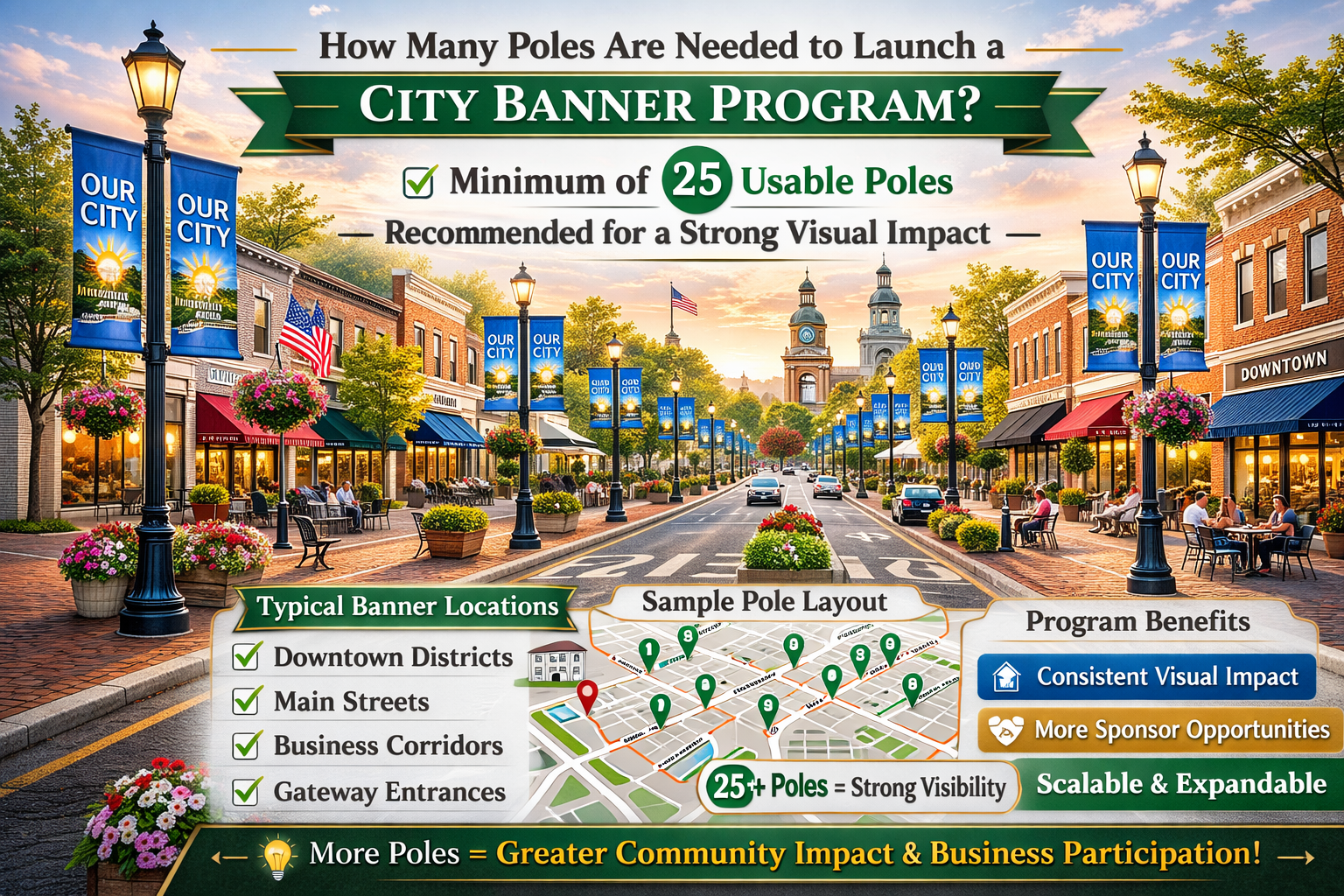
Most sponsorship-funded city banner programs require a minimum of approximately 25 usable poles or streetlamps to launch.
This allows for a consistent visual presence throughout the community and provides enough locations to support local business sponsorship participation.
Why a Minimum Number of Poles Is Important
City banner programs are designed to create a noticeable visual impact.
Having too few banners can limit the effectiveness of the program.
Creates Visual Consistency
A sufficient number of banners ensures that the display feels intentional and cohesive across key areas of the community.
Supports Sponsor Participation
Each banner location represents an opportunity for a local business sponsor.
Having an adequate number of poles allows:
-
multiple businesses to participate
-
flexibility in location selection
-
room for program growth
Makes the Program Sustainable
A minimum number of placements helps support the overall structure of the program, including design, production, and coordination.
What Counts as a “Usable” Pole?
Not every pole or streetlamp is suitable for banner installation.
Cities typically evaluate:
Pole Type
-
decorative streetlamps
-
standard utility poles (if appropriate)
-
poles with existing banner hardware
Spacing and Placement
-
consistent spacing between poles
-
visibility from roadways and sidewalks
-
placement within key corridors
Structural Compatibility
-
ability to support banner brackets
-
height and clearance requirements
-
safety considerations
4. Logo and Artwork Submission
Sponsors provide:
-
company logo
-
optional tagline or messaging
These elements are incorporated into the banner design in a designated recognition area.
5. Banner Design Integration
The sponsor’s branding is placed within the approved banner layout.
The city’s design remains the primary visual, while sponsors are recognized in a consistent and professional format.
6. Production and Installation
Once finalized, banners are:
-
prepared for production
-
manufactured
-
installed on approved poles
Sponsors then see their participation displayed throughout the community.
Where Banners Are Typically Installed
Cities often prioritize high-visibility areas.
Common locations include:
-
downtown districts
-
main streets
-
business corridors
-
gateway entrances
-
parks and community hubs
Can a City Launch with Fewer Than 25 Poles?
Some municipalities may initially identify fewer than 25 poles.
In these cases, cities may:
-
expand into additional corridors
-
include nearby streets or districts
-
phase the program over time
However, most programs are designed to launch with a sufficient number of locations to ensure impact and participation.
Can a City Have More Than 25 Poles?
Yes.
Many cities exceed the minimum requirement.
Larger programs may include:
-
multiple districts
-
expanded corridors
-
additional phases over time
The program can scale based on:
-
available infrastructure
-
sponsor participation
-
city goals
How Cities Identify Banner Locations
The process of identifying poles is typically straightforward.
Initial Review
-
City staff review potential areas for banner placement.
Mapping and Visualization
-
A map is created showing:
-
each approved pole
-
placement layout
-
spacing and distribution
-
Final Approval
-
The city confirms the final list of approved poles before the program moves forward.
What If a City Is Unsure About Its Pole Count?
-
Many municipalities are not certain how many usable poles they have.
In these cases:
-
a collaborative review can be conducted
-
mapping tools can be used to identify locations
-
recommendations can be provided based on the community layout
This process helps cities determine feasibility without requiring extensive upfront effort.
-
Key Takeaways
-
Most city banner programs require a minimum of about 25 poles
-
Usable poles must meet visibility, spacing, and structural criteria
-
Programs can expand beyond the minimum based on participation
-
Cities can work through a mapping process to identify locations
-
The number of poles directly impacts program visibility and success
Related Resources
-
Do City Banner Programs Cost the Municipality Money?
-
How Do Local Business Sponsors Participate in City Banner Programs?
-
How Does a City Banner Program Work from Start to Installation?
- What Does the City Need to Provide for a Banner Program?
-
The Complete Guide to Sponsorship-Funded City Banner Programs
Interested in exploring a sponsorship-funded city banner program for your community?
Contact Community Showcase Banners to learn how the process works.

Matt Cottengim is an experienced professional with a strong background in sales, marketing, workflow automation, and business strategy. He serves as the Brand Affiliate for Community Showcase Banners, Inc., a company that specializes in decorative streetscape banner displays for municipalities. Matt is also an expert in software tools such as WooCommerce, ActiveCampaign, Monday.com, Airtable, Synthflow, Chat GPT, Fillout and Zapier, which he uses to optimize all aspects of the business’s operations.



Community Showcase Banners
130 E. Main St.
Rochester, NY 14604